Degrees of Hearing Loss
What Mild, Moderate, Severe and Profound Mean for You
Quick Answer
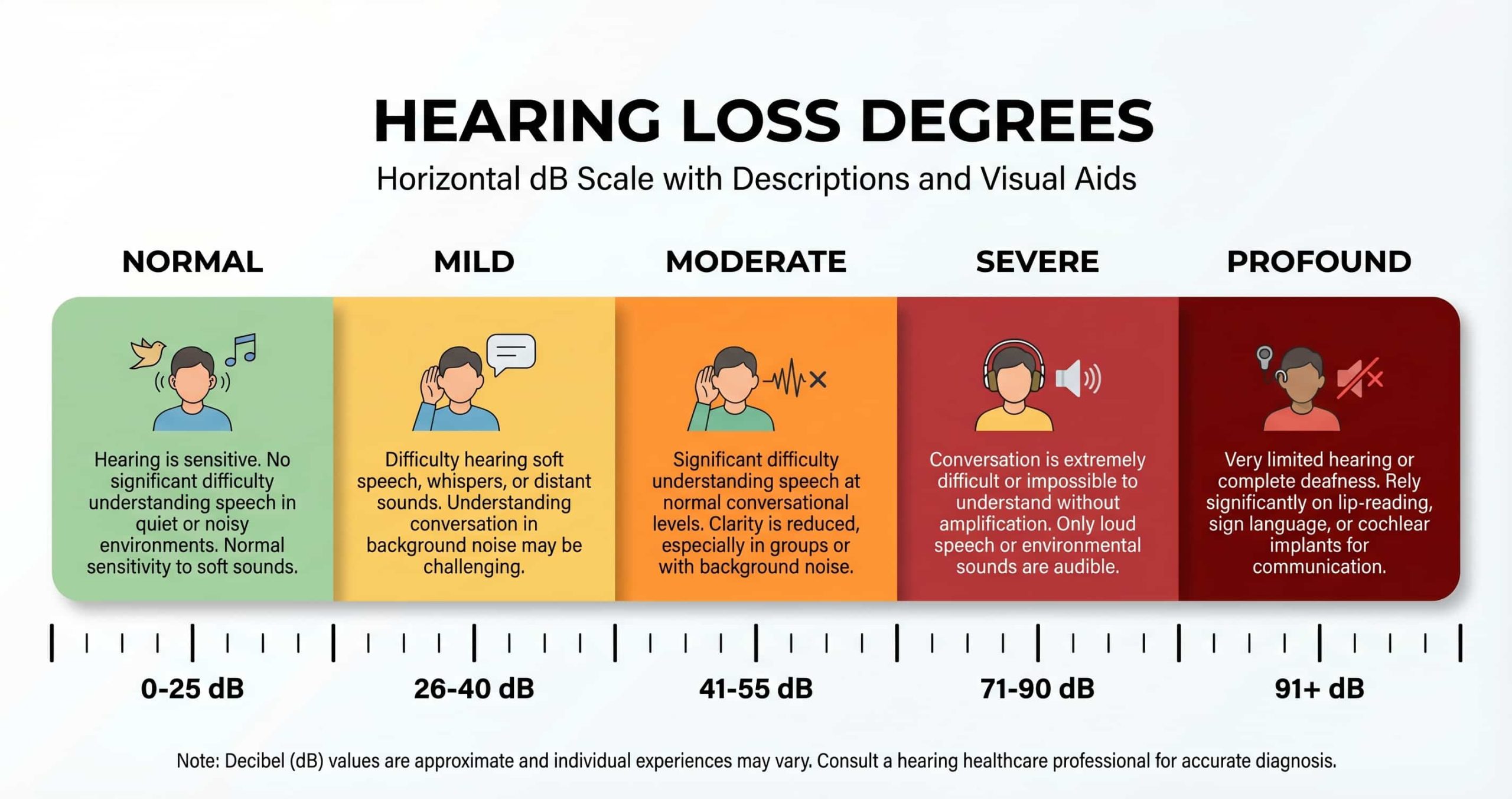
Hearing loss is classified by severity in decibels (dB): Mild (26–40 dB) — you may miss soft speech and whispers; Moderate (41–55 dB) — you may struggle with normal conversation; Moderately Severe (56–70 dB) — you may miss most speech without amplification; Severe (71–90 dB) — you may only hear loud sounds; Profound (91+ dB) — most sounds are inaudible without devices. Normal hearing is 0–25 dB. A hearing assessment measures your thresholds and determines your degree of hearing loss.
When your audiologist tells you that you have “mild hearing loss” or “moderate hearing loss,” those words carry specific clinical meaning — they are not vague descriptions. Hearing loss is measured in decibels (dB) and classified into degrees based on internationally agreed standards. Understanding what each degree means in practical terms — what you can and cannot hear, how it affects daily life, and what management options are available — helps you make informed decisions about your hearing care.
This guide explains each degree of hearing loss using the classification system aligned with the World Health Organization and Audiology Australia, with real-world examples at each level so you can understand what the numbers actually mean for your everyday experience.
How Hearing Loss Is Measured
Hearing loss is measured during a hearing test using pure-tone audiometry. You listen to tones at different frequencies (pitches) and the audiologist determines the softest sound you can reliably detect at each frequency — this is your hearing threshold, measured in decibels hearing level (dB HL). These thresholds are plotted on an audiogram.
The degree of hearing loss is typically determined by averaging the thresholds at key speech frequencies (500 Hz, 1000 Hz, 2000 Hz, and sometimes 4000 Hz). This average is called the pure-tone average (PTA) and is the number used to classify your hearing loss into a degree category.
It is important to understand that hearing loss is rarely uniform across all frequencies. You may have normal hearing in the low frequencies and moderate hearing loss in the high frequencies — a very common pattern in age-related and noise-induced hearing loss. The degree classification provides a useful summary, but the full picture comes from looking at the complete audiogram.
Normal Hearing (0–25 dB HL)
If your hearing thresholds fall between 0 and 25 dB HL across the speech frequencies, your hearing is classified as within normal limits. You should be able to hear soft speech, whispers, and environmental sounds without difficulty in most situations.
That said, “normal” hearing on an audiogram does not always mean “no hearing difficulty.” Some people with normal thresholds still struggle in noisy environments — a condition sometimes referred to as hidden hearing loss, where the issue lies in the neural processing of sound rather than the sensitivity of the ear. If you have difficulty hearing in noise despite normal test results, mention this to your audiologist.
Mild Hearing Loss (26–40 dB HL)
What It Means in Daily Life
Mild hearing loss is the most common degree identified in routine hearing assessments — and also the most frequently overlooked, because its effects can be subtle enough to attribute to other causes (“people mumble these days,” “it’s just a noisy restaurant”). With mild hearing loss, you may find that:
- You miss soft speech and whispers
- You struggle to follow conversation in background noise (restaurants, family gatherings, busy offices)
- You need the television volume slightly higher than others prefer
- You sometimes miss parts of phone calls or misunderstand words
- You feel more tired than expected after long conversations or meetings (listening fatigue)
In quiet, one-on-one conversation, you may hear reasonably well — which is why mild hearing loss often goes undetected for years. It is in complex listening environments that the difficulty becomes apparent.
Management Options
Mild hearing loss may benefit from hearing aids, particularly if the hearing difficulty is affecting your quality of life, social engagement, or work performance. Modern hearing aids for mild loss are very discreet — many are virtually invisible. Some people with mild hearing loss choose to monitor and use communication strategies rather than hearing aids, depending on their lifestyle. Your audiologist can discuss whether hearing aids would provide meaningful benefit for your specific pattern of mild loss.
Moderate Hearing Loss (41–55 dB HL)
What It Means in Daily Life
Moderate hearing loss has a noticeable impact on everyday communication. At this level:
- You struggle to follow normal conversational speech without effort, even in quiet
- Group conversations are significantly difficult — you may miss much of what is said when multiple people are talking
- You need the television volume noticeably higher than others in the room
- Phone conversations become challenging — you may avoid phone calls or rely on speakerphone
- You may misinterpret words frequently, leading to misunderstandings
- Listening fatigue becomes a significant daily factor
Moderate hearing loss is the degree at which most people recognise that something has changed and begin to consider professional help. It is also the degree at which the people around you are likely to have noticed and may have mentioned their observations.
Management Options
Hearing aids are strongly recommended for moderate hearing loss. At this level, the communication benefit from amplification is substantial and usually immediately apparent. Mid-range hearing aid technology typically provides excellent results for moderate hearing loss, with good noise reduction and speech enhancement. The cost and funding options for hearing aids vary — your audiologist can help you explore all available pathways.
Moderately Severe Hearing Loss (56–70 dB HL)
What It Means in Daily Life
At this degree, hearing loss significantly impacts nearly all communication situations:
- You miss most normal conversational speech without amplification
- You may only hear speech when the speaker is close, facing you, and speaking clearly
- Group situations and phone calls are extremely difficult without hearing aids
- Environmental sounds (doorbell, microwave beeps, car indicators) may be missed
- You may rely heavily on lip-reading and visual cues to supplement what you hear
Management Options
Hearing aids are essential at this level and should be fitted as a priority. More powerful hearing aid technology is typically required — mid-range to premium devices with strong amplification, advanced noise management, and directional microphone systems. Assistive listening devices (FM systems, remote microphones) may also be recommended for specific situations such as meetings, classrooms, or television listening.
Severe Hearing Loss (71–90 dB HL)
What It Means in Daily Life
Severe hearing loss means that only loud sounds are audible without amplification:
- Normal conversation is not audible without hearing aids
- You may only hear very loud sounds — a dog barking nearby, a car horn, a power tool
- Without hearing aids, communication is limited to visual cues, lip-reading, and written text
- Even with hearing aids, challenging listening environments remain difficult
- Telephone use typically requires amplified or captioned phones
Management Options
Powerful hearing aids are the primary management — typically behind-the-ear (BTE) models with strong amplification capacity. At this level, the audiologist may also begin discussing cochlear implant candidacy if hearing aids are not providing sufficient speech understanding. Communication strategies and auditory training become increasingly important as supplementary supports.
Profound Hearing Loss (91+ dB HL)
What It Means in Daily Life
Profound hearing loss means that most sounds — including loud ones — are not audible without devices:
- Only very loud sounds (above 90 dB) may be detected — and perceived more as vibration than sound
- Speech is not accessible through hearing alone without devices
- Communication relies primarily on visual modes — lip-reading, sign language, written text, or captioning
- Environmental awareness (traffic, alarms, someone approaching) is significantly compromised
Management Options
Cochlear implants are often the most appropriate intervention for profound sensorineural hearing loss, as they bypass the damaged hair cells and stimulate the auditory nerve directly. Some people with profound hearing loss still benefit from powerful hearing aids, particularly if there is some residual low-frequency hearing. The decision between hearing aids and cochlear implants is made through comprehensive audiological and medical assessment, with input from the individual about their goals and preferences.
Management Summary by Degree
- Mild (26–40 dB): Hearing aids may help. Monitor and use communication strategies if not yet ready for devices.
- Moderate (41–55 dB): Hearing aids strongly recommended. Substantial communication benefit from amplification.
- Moderately Severe (56–70 dB): Hearing aids essential. Consider assistive devices for challenging situations.
- Severe (71–90 dB): Powerful hearing aids required. Cochlear implant candidacy may be assessed.
- Profound (91+ dB): Cochlear implants often the most effective intervention. Powerful aids may still help with some residual hearing.
At every degree, the most important first step is the same: a comprehensive hearing assessment with a qualified audiologist who can determine your exact thresholds, the type of hearing loss, and the management approach that matches your needs, lifestyle, and budget.
Find Out Your Degree of Hearing Loss
A hearing assessment at All Ears in Hearing measures your exact thresholds and determines your degree of hearing loss. Our independent, commission-free audiologists will explain what the numbers mean for your daily life and recommend management options tailored to your needs.
Rochedale South: (07) 3841 3764 | Shailer Park: 0478 282 561
Frequently Asked Questions
What are the degrees of hearing loss?
Hearing loss is classified into degrees based on the softest sounds you can hear, measured in decibels (dB): Normal (0–25 dB), Mild (26–40 dB), Moderate (41–55 dB), Moderately Severe (56–70 dB), Severe (71–90 dB), and Profound (91+ dB). These classifications are based on standards aligned with the World Health Organization and Audiology Australia. The degree is determined through a hearing assessment and helps guide which management approach is most appropriate.
What does mild hearing loss sound like?
With mild hearing loss (26–40 dB), you may miss soft speech and whispers, and struggle to follow conversation in background noise. One-on-one conversation in quiet environments may still be manageable, but group settings, restaurants, and phone calls become noticeably harder. Many people with mild hearing loss describe it as feeling like people are mumbling or not speaking clearly, rather than recognising it as a change in their own hearing.
At what degree of hearing loss do you need hearing aids?
Hearing aids may be beneficial from mild hearing loss (26+ dB) onwards, though the decision depends on how the hearing loss affects your daily life, not just the number on the audiogram. At moderate hearing loss (41+ dB), hearing aids are strongly recommended as the communication impact becomes substantial. At moderately severe hearing loss (56+ dB), hearing aids are considered essential. Your audiologist will consider your lifestyle, communication needs, and personal preferences alongside the audiometric results when making a recommendation.
Can hearing loss get worse over time?
Yes. Age-related hearing loss (presbycusis) is progressive and typically worsens gradually over years and decades. Noise-induced hearing loss can also worsen with continued exposure. Other factors that may cause hearing to deteriorate include certain medications, health conditions, and additional noise exposure. Regular hearing assessments — recommended every two years for adults over 50 — allow changes to be tracked and management adjusted accordingly.
What is the difference between hearing loss degree and type?
The degree of hearing loss (mild, moderate, severe, profound) describes how much hearing has been lost — measured in decibels. The type of hearing loss (sensorineural, conductive, mixed) describes where in the ear the problem is located — inner ear, outer/middle ear, or both. Both the degree and type are determined through a hearing assessment and together they guide the most appropriate management approach. For example, moderate conductive hearing loss from ear wax is treated very differently from moderate sensorineural hearing loss from ageing.
Sources and References
- World Health Organization — Hearing loss classification standards
- Audiology Australia — Clinical Practice Standards
- American Speech-Language-Hearing Association (ASHA) — Degree of hearing loss classifications
- Clark, J.G. (1981) — Uses and abuses of hearing loss classification, ASHA
Individual hearing profiles vary. The degree classifications above are general guidelines — your audiologist will interpret your specific audiogram in the context of your lifestyle and communication needs. Information current as of April 2026.