Many hearing aids rely on a few small parts to connect the device to your ear, most commonly domes, tubes and custom moulds. Each plays its own role, and together they help carry sound to where it is needed. Understanding these parts in a general way can help you feel more familiar with how your hearing aids are put together. It also helps you describe anything that does not feel quite right. Hearing aid domes, tubes and moulds are common questions for our Brisbane and Logan clients, and for many people across Australia.
This overview explains domes, tubes and moulds and how they differ. The parts your hearing aids use depend on their style and how they have been set up for you, so your audiologist is the right person to explain the specifics. Consider this a friendly introduction to some common components. Your hearing care professional can show you exactly which parts your devices use.
Hearing aid domes
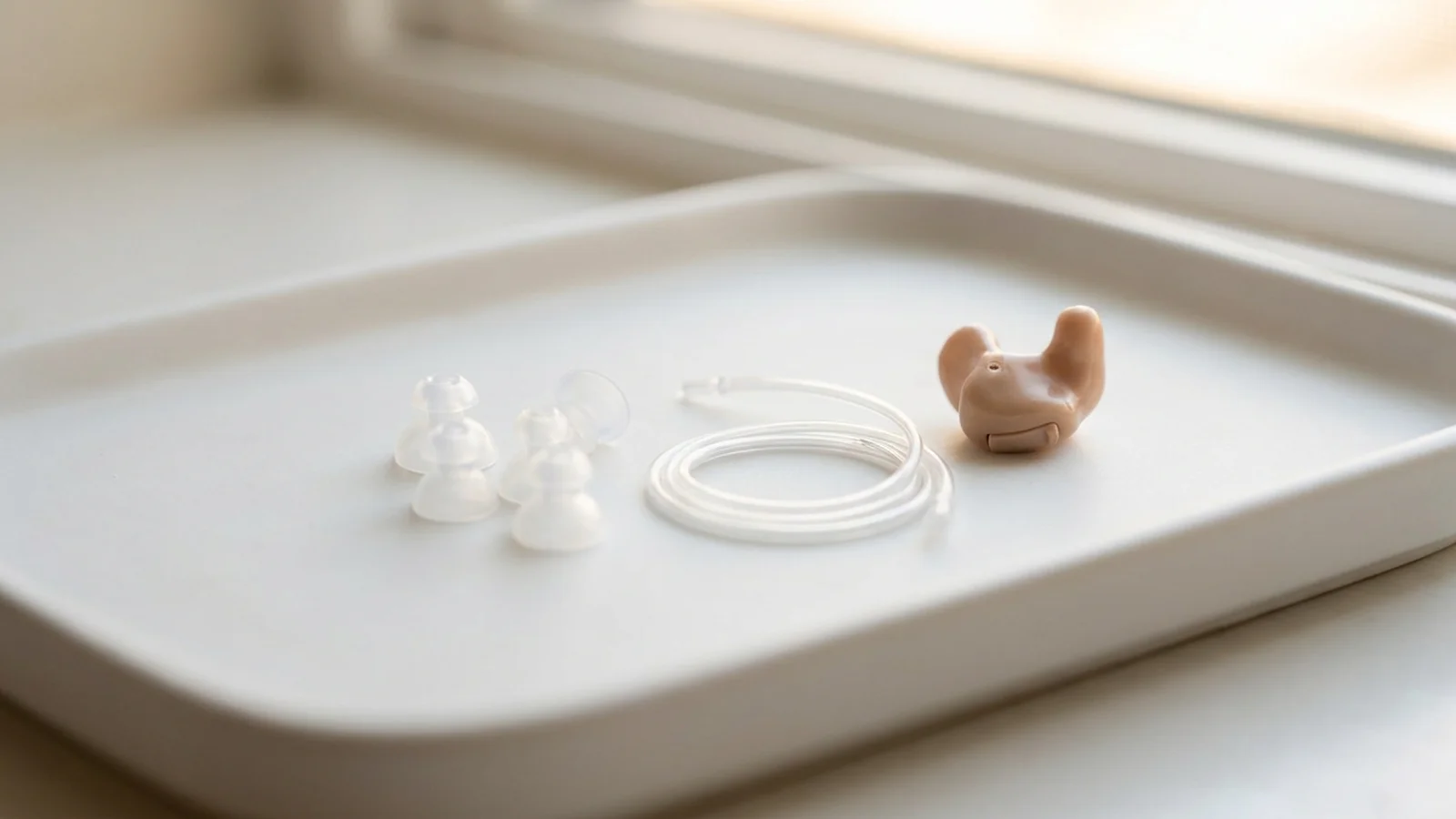
Domes are small, soft tips that attach to the end of certain hearing aids and sit within the ear canal. They are ready-made and come in a range of shapes and sizes to suit different ears. Because they are simple to attach and replace, domes are a popular part of many hearing aid setups. Their convenience is one reason they are so widely used.
The dome style that suits you is decided as part of the fitting process, based on your ears and hearing needs. There is no single dome that works for everyone. Your hearing care professional can explain which dome options are appropriate for your particular devices. They will take the fit into account when choosing.
Tubes and tubing
Tubes are the thin lengths of tubing found on some hearing aid styles, connecting the main body of the device to the part that sits in the ear. They help guide sound along its path and are shaped to sit neatly around the ear. Tubes come in different lengths and thicknesses to suit different people. A well-fitting tube helps the device sit neatly.
Over time, tubing can become stiff or gather moisture, so it is sometimes replaced as part of ongoing care. This is a normal part of maintaining a hearing aid. Your audiologist can check the tubing on your hearing aids at your appointments. They can let you know when a little attention might be helpful.
Custom moulds and earmoulds
Custom moulds, or earmoulds, are made to match the individual shape of a person's ear. Because they are tailored to you, they can provide a more personalised fit for some people. Making a mould usually involves taking an impression of the ear so it can be crafted to your ear's contours. This is a straightforward and routine step.
Moulds are often considered where a more secure or individualised fit is helpful. They are shaped specifically for the person who will wear them. Whether a mould suits your situation is something your hearing care professional can discuss with you. They will take your ears and your devices into account.
How these components differ
The main differences come down to how each part fits and what it does. Domes and moulds are the pieces that sit in the ear, with domes being ready-made and moulds custom-crafted, while tubes connect the device to these end pieces on certain styles. Together they form the pathway that carries sound to your ear. Each part has its own simple purpose.
Not every hearing aid uses all of these parts, as it depends on the style and design. Some devices use just one or two of them. During a fitting, your audiologist can show you exactly which parts your devices use. They can explain how everything fits together in plain terms.
Cleaning domes, tubes and moulds
Because these parts sit in or near the ear, they can gather earwax, moisture and everyday debris, so gentle cleaning is helpful. Wiping them with a soft, dry cloth is a common daily habit, and your hearing care professional can demonstrate the correct method for each part. Keeping this area clean is a normal part of hearing aid care. A quick clean at the end of the day usually does the job.
- Wipe parts gently with a soft, dry cloth
- Avoid water, solvents and sharp objects
- Check for wax or debris as part of your routine
- Ask your audiologist about replacement timing
Replacement and maintenance
If a dome, tube or mould feels loose or sore, or looks worn, it is worth speaking with your hearing care professional. These small parts are replaced from time to time as part of general maintenance, and getting them checked helps keep your devices in good order. There is no need to wait for a scheduled appointment if something does not feel right. Reaching out early often makes things simpler to resolve.
Your ears can change gradually, which may affect how these parts fit over time. This is a common part of wearing hearing aids, and your audiologist can check the fit for you. Regular check-ins with your audiologist help keep everything working as intended. They also keep the parts well suited to you as the months go by.
Getting familiar with the parts
In the early days of wearing hearing aids, it can help to become familiar with how the domes, tubes or moulds attach and sit. Your audiologist can show you how the parts connect, so handling them feels less daunting. With a little practice, most people find this becomes straightforward.
If you are ever unsure how a part fits or comes away, there is no need to force anything. A gentle approach is always the safest. Your hearing care professional can demonstrate the right technique for your particular devices.
If you would like to learn more, or to arrange a hearing appointment, you are welcome to get in touch with our friendly team. No referral is necessary, and we are happy to answer any questions you may have.
DISCLAIMER:
The information on this website is provided for educational purposes only. We do not support, nor recommend any products or treatments without proper hearing diagnostic and proper hearing evaluation. All users must seek professional advice before beginning treatment as well as inform themselves of known side effects/risks associated with said procedure(s).
Disclaimer: The information in this article is general in nature and provided for educational purposes only. It does not take into account your individual circumstances and is not a substitute for professional advice. Please consult a qualified hearing health professional about your specific needs.
Related articles
- Understanding Hearing Aid Domes and Moulds
- Hearing Aid Cleaning and Maintenance Kits Explained
- Directional Microphones in Hearing Aids Explained
Looking for a hearing test or ear care? See hearing tests, hearing aids or book an appointment. Browse all articles.